The ICBC was founded on January 1, 1984, and is a completely state-owned bank. This means that the capital for the bank is provided by the Chinese Ministry of Finance, making it one of the most powerful institutions in the world.
As of September 2023, ICBC Is also the third-largest bank in the world by market capitalization behind only JPMorgan Chase and Bank of America. As recently as 2018, ICBC was the world’s largest bank by total assets under management. Not surprisingly, ICBC Is a systemically important bank to the global economy according to the Financial Stability Board.
As of the end of 2022, ICBC had more than 10 million corporate customers and a staggering 720 million retail customers. This is easily the highest number of customers among Chinese banks and around the world.
Industrial and Commercial Bank of China History
ICBC was created in 1984 and was the last of the four Chinese banks to be established. Originally, ICBC was created to “undertake the business of industrial and commercial credit and savings previously handled by the People’s Bank of China”, according to their corporate history. Of course, today ICBC offers plenty of other services for both consumer and corporate clients.
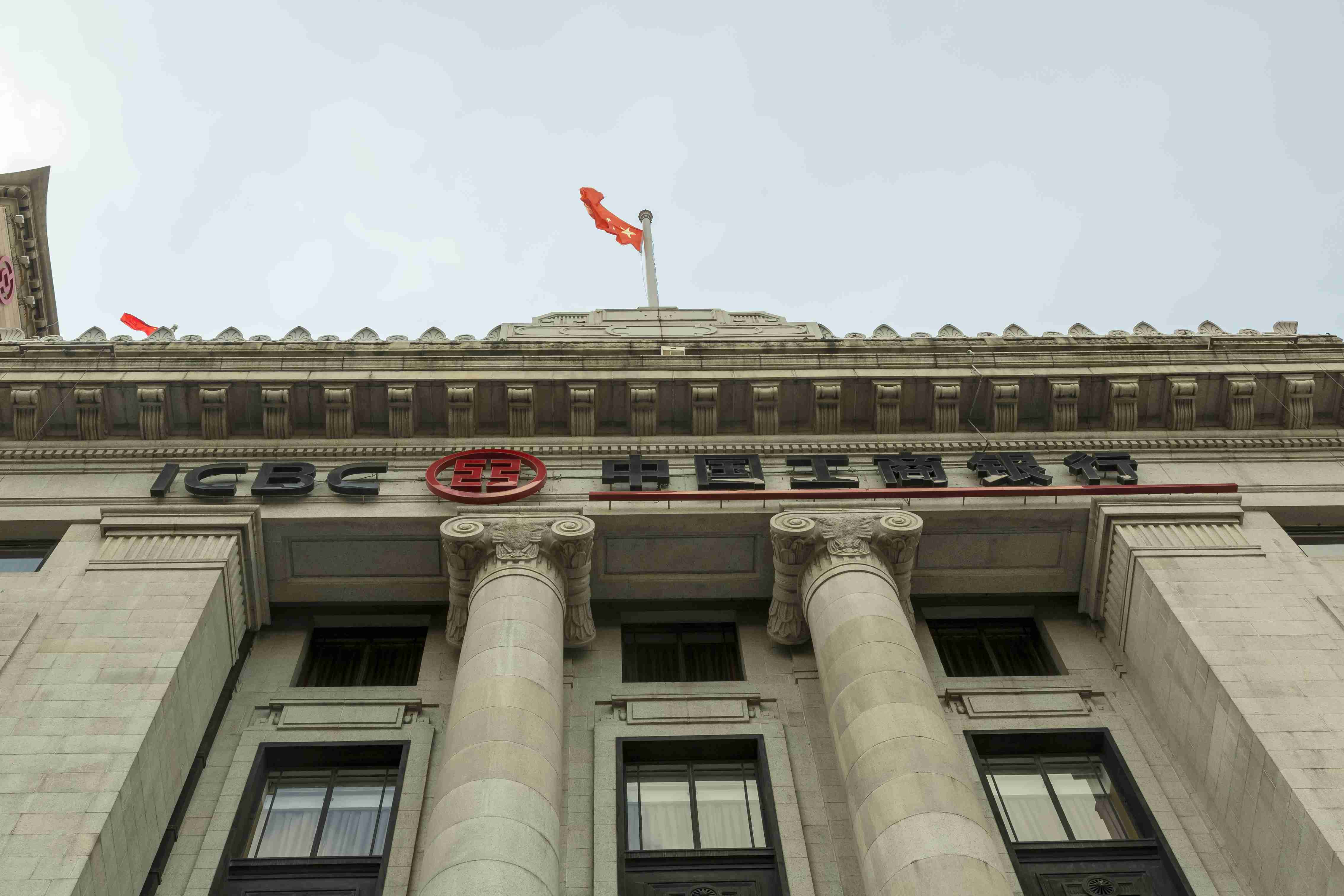
In 2006, the Industrial and Commercial Bank of China went public on the Hong Kong and Shanghai stock exchanges. At the time, the ICBC IPO was the largest in history as it was valued at nearly $22 billion, surpassing the previous largest IPO which was Japan’s NTT Docomo telecommunications company.
As with many businesses in China, ICBC has seen a volatile performance since the COVID-19 pandemic. China’s economy was one of the hardest hit during the pandemic due to the government’s strict lockdown and economic restrictions. Since then, China’s recovery has fluctuated and although it has shown signs of a rebound, the economy remains strained and has lagged behind the recovery of other major economies.
Industrial and Commercial Bank of China’s Stock
ICBC’s A-Shares trade on the mainland China exchange in Shanghai under the ticker symbol SSE: 601398. A-Shares are typically only available to traders within China which makes them less liquid than the Hong Kong-listed H-Shares. Both stocks also have different prices as H-Shares trade in Hong Kong Dollars (HKD) and A-Shares trade in Chinese Yuan.
Neither stock trades for a very high price relative to other major banks around the world. ICBC’s market capitalization sits at around USD 220 billion as of September 2023, which puts it at about an equal size to Bank of America and roughly half the size of JPMorgan Chase. Why is the stock price so low? ICBC has a massive float of outstanding shares totalling more than 86 billion shares. This dwarfs the outstanding shares of Bank of America’s 7.95 billion and JPMorgan Chase’s 2.91 billion. Outstanding share count has a direct impact on the price of the stock and is the figure used to calculate the company’s market capitalization.
As for the stock’s performance, neither the H-Shares nor the A-Shares of ICBC have impressive historical stock charts. Over the past five years, ICBC’s H-Shares have returned a loss of about 33.6% and the A-Shares a loss of 18.4%. Since the IPO in 2006, ICBC’s H-Shares have returned a modest gain of 10.6% while the A-Shares have risen by about 42.9%.
Industrial and Commercial Bank of China Dividend
Despite the high dividend yield, ICBC has a respectable payout ratio of about 31% which means the dividend is relatively safe and should continue to be paid moving forward. The dividend payout ratio is a calculation of the dividends paid out to shareholders as a percentage of the company’s total net income.
Despite the high dividend yield, ICBC has a respectable payout ratio of about 31% which means the dividend is relatively safe and should continue to be paid moving forward. The dividend payout ratio is a calculation of the dividends paid out to shareholders as a percentage of the company’s total net income.
Industrial and Commercial Bank of China Products and Services
ICBC also offers banking through the popular WeChat super app. WeChat provides integration with an ICBC bank account and users can message for support or help directly through the WeChat app. ICBC also has simple SMS banking where users can access services like account activities, account inquiries, service customization, bill payments, and mobile phone top-ups directly through an SMS messaging service.
Industrial and Commercial Bank of China Corporate Outlook
Progress is another central pillar of ICBC’s business and is meant to strengthen the foundation of high-quality development in China. Reform alludes to ICBC’s continued innovation in the Chinese financial sector. This refers to ICBC’s many digital services offerings to both retail and corporate customers. As the banking industry continues to evolve in China, ICBC is at the forefront of technological advancement in providing its millions of customers with the latest banking technology.
There are currently 13 members of the ICBC Board of Directors, led by the Chairman and Executive Director of the bank: Chen Siqing. The bank has had several prominent figures graduate to represent the Chinese government with high-ranking positions in the Chinese Communist Party.
What Does the Future Hold for the Industrial and Commercial Bank of China?
One hindrance to investing in ICBC is the abnormally large share count which has certainly kept the stock price in check. As long as the share float stays at or around 86 billion shares, the price is going to remain depressed and the dividend yield will remain high.
As for the future performance of ICBC, it will always be tied directly to the health of the Chinese economy. With the global economy still being repaired and trying to tackle high inflation, economies have been on shaky ground for the past couple of years. China is no exception and has seen particular weakness in manufacturing and real estate in recent months. The Chinese government has intimated that stimulus will help prop up the economy until inflation has passed.
While China has long been seen as the manufacturing and export capital of the world, it is also improving other sectors like corporate lending. Recently, ICBC was chosen as the bookrunner for a massive USD 11 billion loan to Saudi Arabia. The deal includes long-term senior, unsecured loans to the Empire. It is just one in a series of new loans being issued by Chinese or overseas banks to the Kingdom of Saudi Arabia.
There is little doubt that ICBC will continue to dominate the domestic Chinese banking industry. It is by far the largest bank in China and boasts nearly half of all retail bank accounts in the country. Capital appreciation likely isn’t in the forecast for ICBC stock as shares have only posted modest gains over the past 17 years. The dividend is nice but remember, it is only paid out once per year.
ICBC is the foundational bank in the Chinese economy and the cornerstone of the Chinese financial world. As an investment, the stock performance has been lacklustre. As a business, ICBC remains one of the most systemically important banks in the world and holds a major share of China’s retail banking industry.