
It is currently the second-largest bank in China and the fourth-largest bank in the world by market capitalization. AgBank trails only ICBC or the Industrial and Commercial Bank of China within its domestic market. Internationally, AgBank is smaller than only JPMorgan Chase and the Bank of America.
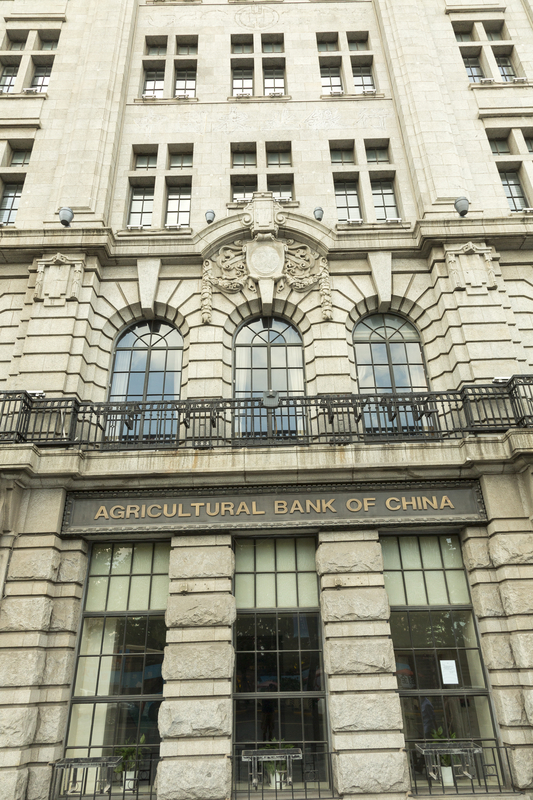
As with most commercial banks, AgBank offers several consumer and corporate services, primarily for customers in China. These include personal and enterprise banking, investment and global wealth management, insurance, credit cards, and mortgages. Not surprisingly given its status as one of the world’s largest banks, it is considered by the Financial Stability Board (FSB) as a systemically important bank.
A History of the Agricultural Bank of China

As mentioned, the AgBank was established in 1951, although the current iteration we know today was founded in 1979. The Agricultural Bank of China has its roots in the merger between the Republic of China Bank and the Farmer’s Bank of China that took place in 1951. The history following this merger is convoluted as the first bank to use the name Agricultural Bank of China came in 1955. Just two years later, this version of the Agricultural Bank of China was merged with the country’s Central Bank.
It wasn’t until 31 years later in 2010 when the Agricultural Bank of China held its IPO and began trading on both the Hong Kong and Shanghai exchanges. At the time, the IPO set the record for the largest in history, eclipsing the IPO of the Industrial and Commercial Bank of China in 2006. It remained the largest IPO in history until 2014 when another Chinese company debuted publicly: AliBaba.
Like most businesses, the Agricultural Bank of China does have some blemishes on its record. The most glaring one is when two bank managers at an AgBank branch embezzled nearly USD 7.5 million. To this day, it is the largest bank robbery in Chinese history. The Agricultural Bank of China has had some ties to North Korea as well and in 2013, the United States accused the bank of funding North Korean missiles and nuclear weapons programs.
Agricultural Bank of China’s Stock
As with many Chinese companies, AgBank offers both A-Shares and H-Shares of the stock. Since 2010, the two types of shares have had significantly different performances. Why would the two stocks have different returns? The H-Shares which trade in Hong Kong are known to be much more liquid with more global trading exposure. The A-Shares are limited to mainland China investors and a large percentage of these shares are owned by the Chinese government.

Agricultural Bank of China’s H-Shares has returned a loss of about 12% since the company went public. Meanwhile, the A-Shares have returned nearly 35% to shareholders since 2010. Neither performance is very noteworthy as both have trailed broader market indexes over that same period.
The A-shares are mostly owned by state-owned agencies and corporations. An estimated 84% of Agricultural Bank’s A-Shares are owned by insiders while only 8.4% are owned by institutions. As for the H-Shares, only 4.15% are held by insiders while 27.81% are owned by institutions. Typically, the statistics and liquidity of H-Shares are more indicative of the actual stock.
Similar to other Chinese big banks, the single-largest shareholder of the company is Central Huijin Investment, which owns roughly 40% of the shares. Multiple other majority shareholders of Agricultural Bank are also state-owned organizations of the Chinese government.
Agricultural Bank of China’s Dividend

One of the main reasons why investors like to choose bank stocks is because they often pay a healthy dividend. Chinese banks are no exception and the Agricultural Bank of China offers shareholders an annual distribution with a yield of 6.14% for the A-Shares and 8.31% for the H-Shares. How have these dividend yields performed historically? The A-Shares have a 5-year average dividend yield of 5.75% and the H-Shares have a 5-year average dividend yield of 7.42%.
When it comes to the Agricultural Bank of China’s dividend growth rate, it is all over the map. Consistent annual dividend growth isn’t a hallmark of AgBank’s stock. As of 2023, the 10-year annual dividend growth rate is about 3.82%, while the five-year growth rate is a respectable 4.96%. Note that this data refers to the OTC version of the stock that trades on the US markets. Dividend payouts should be similar to what they would be if you held the Chinese-listed stocks, although OTC shares trade in US dollars so there are some exchange differences.
Agricultural Bank of China Products and Services

Deposit accounts are offered in both RMB and foreign currencies if requested. Agricultural Bank pays interest on any deposits, which are based on the country’s prime rates, although have recently lowered the rates to protect profitability in what has been a challenging macroeconomic environment.
Customers can also get access to a wide variety of debit cards and credit cards depending on what type of banking they do. As with American offerings, Chinese credit cards include travel rewards systems, business credit cards, entertainment, and platinum status. Agricultural Bank also offers the quasi-credit card which is unique for its clients. This card acts as a hybrid debit and credit card and allows users to use it for settlement, purchases, and even wealth management services. The bank is also planning to release a Kins Credit Card with UnionPay standards for the new generation of AgBank clients.
Wealth management services offer all of the options that most major banks normally do. This includes stocks, bonds, precious metals, futures, and foreign exchange. As with most other financial institutions in China, the Agricultural Bank also includes integration with both WeChat and Alipay which are the two largest fintech platforms in the country. It also offers all of its services online and through a mobile app, as well as SMS and television banking.
Finally, AgBank also has a program for entrepreneurs who are looking to start small or medium-sized businesses in county areas. These financial services include a wide range of business loans, SME Plant Mortgage loans, and real estate loans.
What Does the Future Hold for the Agricultural Bank of China?

One advantage that Agricultural Bank has over its peers is its exposure to the Chinese agricultural industry. This industry has a massive workforce and is crucial to the more than 1.3 billion people who live in the country. As long as the Chinese government continues to support the farmers, AgBank seemingly has at least a large percentage of that group who need specialized Agro-Related Business solutions. This is likely a major reason why the Agricultural Bank has the second-largest client base in China.
As an investment, there are some serious headwinds that Chinese banks are facing right now. A slower-than-expected economic recovery paired with stubborn government policies from the CCP could mean that China continues to lag behind the rest of the major economies. While there is no doubting China’s prowess as the manufacturing capital of the world, the financial system is extremely fragile. Chinese banks could be in for some more downward pressure and investors may look at other bank stocks if they do not like AgBank’s annual dividend distribution schedule. Either way, it is a tenuous time for Chinese bank stocks right now, although value investors could find these as bargains ahead of an eventual recovery.